Hey Guys, and welcome back to my journalism blog! For this post I have chosen to focus on what has been one of the fastest growing controversies and concerns for the world, these past few months: The Coronavirus. Since it’s initial outbreak in Wuhan, China, the virus has left thousands dead, tens of thousands sick, and millions in a state of panic, shock and concern. Governments across the world have classified the outbreak of the disease as a reason for a state of emergency, given the severity of its’ danger levels. Below I have disclosed a brief timeline of events surrounding the coronavirus and the effect it is having on individuals across the world:
December 31st
The government in Wuhan, China reported that their health facilities have been treating several cases of an “unknown” virus. During this time there was no clear clarification on its origins, level of severity or method of contamination.
January 11th
China reports its first known death from the Coronavirus. The death was reported as a 61-year old man, and came during a time in which thousands of people were traveling to and from this region, due to holidays.
January 20th
Confirmed Cases were announced in other countries, likely from traveling to areas in which were already infected. The first man in the United States to have symptoms was announced in Washington, as a 31-year old man displayed such after traveling to Wuhan.
January 23rd
The Chinese government closed off the city of Wuhan, halting all transportation to and from the city of nearly 11 million. There was hope that this would decrease the rate of contamination outside of the city.
February 2nd
The first death was announced outside of China, in the Philippines. At this time, over 300 people have already died within China.
March 1st
The first death in the United States was announced, as a man in Rhode Island fatally became victim to the disease.
I chose the Coronavirus as my topic for this blog because, quite frankly, the disease is a concern for millions across the globe. It is very interesting to dive into what makes this disease tick, as well as the reactions from around the world. Through pictures, I will attempt to convey the severity of this epidemic, as well as showcase some of the effects it has had on people.
This photo is one I would consider to be a portrait shot. Although it encompasses a variety of people, the focus seems to be the women in the middle. Shot in china, the picture depicts the level of severity of the disease by showcasing the precautions taken by individuals to avoid contamination of the disease. I, myself, have seen masks worn by students across my college campus. Whether it be for Coronavirus or other diseases, it shows the degree in which people are handling the virus.

Photo Credits: NY Times

This picture is a display of the city of Wuhan prior to the outbreak of the Coronavirus, and following the announcement of the disease. The bottom portion shows the city before, buzzing with people and traffic. The top satellite capture is the city following the announcement, almost deserted in a sense. A scene setter photo, this image depicts the severity of the disease, and the effects it has had on the people in its region of origin, and most contamination.
Photo Credits: Business Insider
Photographed in a market located in Wuhan, China, this medium shot displays an image of people shopping for food. While everything seems to be ordinary, one thing stands out: the presence of masks. This shot depicts the concern of people by showcasing a level of precaution, even during their everyday lives. Narrowing in on the events that are happening not only within Wuhan, but across the world.

Photo Credits: Google Images.

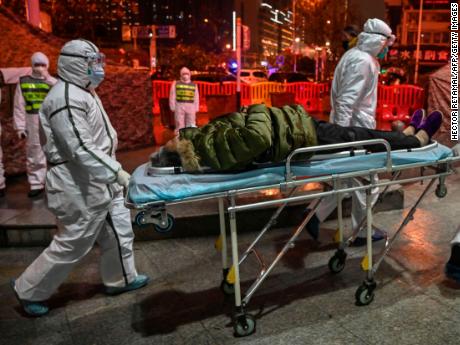
This photograph shows medical respondents wheeling, what looks to be, a victim of Coronavirus towards a hospital. The Contamination suits the individuals have on, as well as the people in the back, displays the severity of the disease, as the surrounding people are avoiding in and all contact with the contaminated
Photo Credits: CNN
This photo truly captures a story. The image depicts two individuals, who look to be like parents, covering their child’s face with a mask to prevent contamination from the disease. The photo emphasizes the levels in which people are going to protect themselves and those they love.

Photo Creds: CNN
The images I have chosen, as well as the arrangement, combine to create the story behind the Coronavirus. I begin by introducing the main topic of the virus: People. I then transition into the effects the virus has had on people, focusing mainly on the area in which it has most affected, Wuhan. The picture depicts the depth in which the effects of the disease have run, even from a macroscopic level. My third and fourth picture depict the severity of the disease by outlining individuals in action, as well as a medium shot to display how people are reacting to the disease. This transitions to a semi-personal level, as I am now again focusing on people.The last photo depicts the story on a very personal level, showcasing an emotional lense into the story of Coronavirus.
I believe that we are transitioning into more photo-dependent journalism. This transition allows the story to be told through pictures and interpreted as such, and I believe this method allows for a deeper effect. A picture is worth a thousand words. Going forward I feel like there are a few ethical dilemmas this process could run into. Taking photos without consent of the individuals depicted can sometimes be a problem, however, it is important that for real news there are real situations photographed, not staged. It will be interesting going forward to see how photography affects journalism in different ways!
Until next time! -Zoe Young
 Zoe's Journalism Blog